
SZTU hosts the 7th Sino-German Symposium on Intelligent Robots
作者: yl7703永利官网 日期: 2026/10/30From October 24 to 25, the 7th Sino-German Symposium on Intelligent Robots (SGIR) was held at Shenzhen Technology University (SZTU). Hosted by the Chinese Computer Society in Germany (GCI) and co-organized by SZTU’s School of Artificial Intelligence (SAI), Sino-German College of Intelligent Manufacturing, and the Institute of Interdisciplinary Medicine and Engineering, this year’s symposium focused on “How Embodied AI Empowers Different Forms of Robots.” The event attracted over 50 experts from academia, industry, and investment sectors, alongside student representatives.
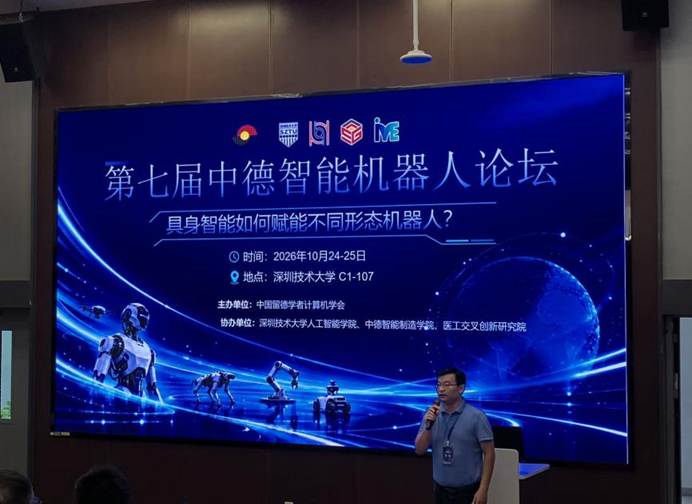
The forum opens with a focus on how embodied AI empowers different robots. [Photo/School of Artificial Intelligence]
During the opening session, Prof. Li Qiang from SAI, a council member of GCI and the initiator of the symposium, introduced the forum’s background. Founded in Bad Herrenalb, Germany, in 2016, the SGIR has been successfully held six times and has grown into a regular platform for academic exchange among robotics scholars from both China and Germany. Prof. He Xiuqiang, vice dean of SAI, noted that China and Germany share a solid foundation for cooperation in robotics and AI, expressing his hope that the forum will further strengthen academic ties and promote joint research.
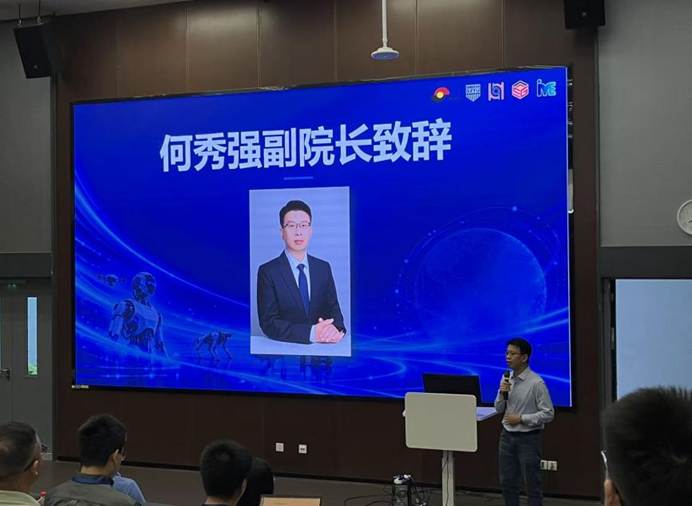
Prof. He Xiuqiang, delivers a speech at the symposium. [Photo/School of Artificial Intelligence]
The symposium featured eight presentations delivered by five distinguished returning scholars from Germany and three scholars from SZTU, focusing on key challenges in embodied AI. Key topics included the bottlenecks in high-quality action data acquisition and embodiment mapping for imitation learning; the evolution of brain-computer interfaces from motor control toward intent understanding and shared autonomy; the scientific challenges of robotic grasping and manipulation in cluttered scenes and with transparent objects; and the application of soft and medical robotics.
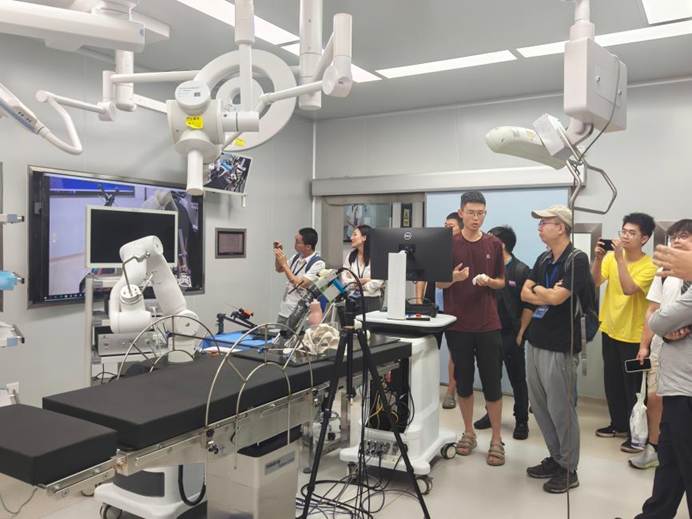
Guests visit the robotics laboratory. [Photo/School of Artificial Intelligence]
These in-depth exchanges not only shared the latest research progress but also laid a solid foundation for future Sino-German scientific collaboration and talent cultivation. Following the presentations, guests visited the laboratories of SAI, the Sino-German College of Intelligent Manufacturing, and the College of Health and Environmental Engineering.
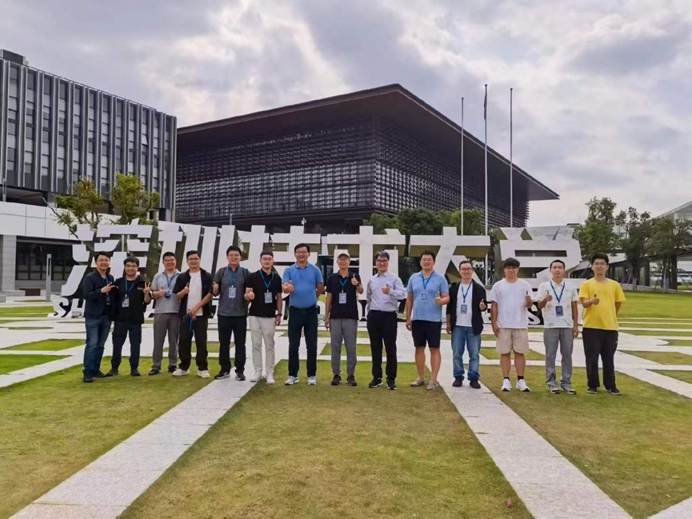
Group photo of the attendees [Photo/School of Artificial Intelligence]
Written by LIN Junzhong / School of Artificial Intelligence, Class of 2029
Reviewed by YAO Qi / School of Artificial Intelligence